HFNets: Difference between revisions
No edit summary |
No edit summary |
||
| Line 1: | Line 1: | ||
<h1>HF | <h1>HF Nets</h1> | ||
The following index has been created to track various efforts to utilize the HF bands for node hopping and mail forwarding. There are some existing networks that are primarily focused on casual operating, keyboard to keyboard messaging for personal mail delivery. Due to the nature of AFSK and SSB, it is possible to have many combinations of VFO dial frequency with audio tone selection. Please see [http://wa8lmf.net/aprs/SSB_Frequencies.htm WA8LMF's excellent article] on their relationship. It is also possible to run multiple, concurrent modems as long as their audio pass range fits within the radio's SSB filter. These ranges can vary, but generally runs around 300-3000 Hz. The two most popular protocols are AX.25/FX.25 (compatible) and IL2P. The AX.25/FX.25 protocols use NRZI encoding, which means USB and LSB can communicate as long as the center frequencies match. The IL2P protocol uses NRZ encoding, which means sideband selection must match. The seeming standard for HF IL2P seems to be USB. For compatibility reasons, it is suggested to run USB for both AX.25/FX.25 and IL2P. This also aligns with VARA, ARDOP and Mercury modems using USB. Traditionally, AX.25 HF packet was LSB by convention, but can support both. For those running hardware based TNCs that do not support IL2P and have fixed tones at 1600:1800 Hz (1700 Hz center), LSB frequencies are provided. | The following index has been created to track various efforts to utilize the HF bands for node hopping and mail forwarding. There are some existing networks that are primarily focused on casual operating, keyboard to keyboard messaging for personal mail delivery. Due to the nature of AFSK and SSB, it is possible to have many combinations of VFO dial frequency with audio tone selection. Please see [http://wa8lmf.net/aprs/SSB_Frequencies.htm WA8LMF's excellent article] on their relationship. It is also possible to run multiple, concurrent modems as long as their audio pass range fits within the radio's SSB filter. These ranges can vary, but generally runs around 300-3000 Hz. The two most popular protocols are AX.25/FX.25 (compatible) and IL2P. The AX.25/FX.25 protocols use NRZI encoding, which means USB and LSB can communicate as long as the center frequencies match. The IL2P protocol uses NRZ encoding, which means sideband selection must match. The seeming standard for HF IL2P seems to be USB. For compatibility reasons, it is suggested to run USB for both AX.25/FX.25 and IL2P. This also aligns with VARA, ARDOP and Mercury modems using USB. Traditionally, AX.25 HF packet was LSB by convention, but can support both. For those running hardware based TNCs that do not support IL2P and have fixed tones at 1600:1800 Hz (1700 Hz center), LSB frequencies are provided. | ||
<div id="main"> | <div id="main"> | ||
<table valign="TOP" border="1"> | <table valign="TOP" border="1"> | ||
<caption><h1>Current HF Packet | <caption><h1>Current HF Packet Nets</h1></caption> | ||
<tr> | <tr> | ||
<td align="center">Name</td> | <td align="center">Name</td> | ||
| Line 79: | Line 79: | ||
<div id="main"> | <div id="main"> | ||
<table valign="TOP" border="1"> | <table valign="TOP" border="1"> | ||
<caption><h1>Proposed/Experimental HF Packet | <caption><h1>Proposed/Experimental HF Packet Nets</h1></caption> | ||
<tr> | <tr> | ||
<td align="center">Name (Compatible NET)</td> | <td align="center">Name (Compatible NET)</td> | ||
| Line 148: | Line 148: | ||
<div id="main"> | <div id="main"> | ||
<table valign="TOP" border="1"> | <table valign="TOP" border="1"> | ||
<caption><h1>Proposed/Experimental HF Mixed Mode | <caption><h1>Proposed/Experimental HF Mixed Mode Nets</h1></caption> | ||
<tr> | <tr> | ||
<td align="center">Name</td> | <td align="center">Name</td> | ||
| Line 298: | Line 298: | ||
With the overarching goal of linking systems statewide, we must also employ antenna systems that favor [https://en.wikipedia.org/wiki/Near_vertical_incidence_skywave NVIS] type propagation. In general, this means horizontal (usually wire) antennas 1/8-1/4w wavelength above the ground or magnetic loops which are oriented vertically. For those interested in actual field strength tests, [https://www.w8ji.com/nvis_n_v_i_s_antenna.htm W8JI's NVIS page] shows the height to performance numbers. | With the overarching goal of linking systems statewide, we must also employ antenna systems that favor [https://en.wikipedia.org/wiki/Near_vertical_incidence_skywave NVIS] type propagation. In general, this means horizontal (usually wire) antennas 1/8-1/4w wavelength above the ground or magnetic loops which are oriented vertically. For those interested in actual field strength tests, [https://www.w8ji.com/nvis_n_v_i_s_antenna.htm W8JI's NVIS page] shows the height to performance numbers. | ||
For a quick reference, here are optimal antenna heights per band. Conventional wisdom suggest NVIS primarily happens below about 10 MHz, though [https://ohiopacket.org/images/tmp/20M_NVIS.png real world testing] with a vertical magnetic loop at | For a quick reference, here are optimal antenna heights per band. Conventional wisdom suggest NVIS primarily happens below about 10 MHz, though [https://ohiopacket.org/images/tmp/20M_NVIS.png real world testing] with a vertical magnetic loop at 3ft above the ground has yielded contacts well beyond groundwave, but well within NVIS ranges. More experimentation may be needed to test it's feasibility on modes which require stronger signals. | ||
<div id="main"> | <div id="main"> | ||
Revision as of 16:21, 27 May 2026
HF Nets
The following index has been created to track various efforts to utilize the HF bands for node hopping and mail forwarding. There are some existing networks that are primarily focused on casual operating, keyboard to keyboard messaging for personal mail delivery. Due to the nature of AFSK and SSB, it is possible to have many combinations of VFO dial frequency with audio tone selection. Please see WA8LMF's excellent article on their relationship. It is also possible to run multiple, concurrent modems as long as their audio pass range fits within the radio's SSB filter. These ranges can vary, but generally runs around 300-3000 Hz. The two most popular protocols are AX.25/FX.25 (compatible) and IL2P. The AX.25/FX.25 protocols use NRZI encoding, which means USB and LSB can communicate as long as the center frequencies match. The IL2P protocol uses NRZ encoding, which means sideband selection must match. The seeming standard for HF IL2P seems to be USB. For compatibility reasons, it is suggested to run USB for both AX.25/FX.25 and IL2P. This also aligns with VARA, ARDOP and Mercury modems using USB. Traditionally, AX.25 HF packet was LSB by convention, but can support both. For those running hardware based TNCs that do not support IL2P and have fixed tones at 1600:1800 Hz (1700 Hz center), LSB frequencies are provided.
| Name | Band | Center Frequency | Speed | Protocol | Usage/notes | Dial Frequency+Tone pairs |
| NET105 | 20M | 14.103.3 | 300 Baud | AX.25/FX.25 | Keyboard to Keyboard | 14.102.0 MHz USB, 1300 Hz (recommended) | 14.105.0 MHz LSB, 1700 Hz |
| NET105 | 20M | 14.104.3 | 300 Baud | IL2P | Keyboard to Keyboard | 14.102.0 MHz USB, 2300 Hz |
| NET40 | 40M | 7.102.3 MHz | 300 Baud | AX.25/FX.25 | Keyboard to Keyboard | 7.101.0 MHz USB, 1300 Hz (recommended) | 7.104.0 MHz LSB, 1700 Hz |
| NET40 | 40M | 7.103.3 MHz | 300 Baud | IL2P | Keyboard to Keyboard | 7.101.0 MHz USB, 2300 Hz |
| NET80 | 80M | 3.597.0 MHz | 300 Baud | AX.25/FX.25 | Keyboard to Keyboard | 3.596.0 MHz USB, 1000 Hz (recommended) | 3.598.7 MHz LSB, 1700 Hz |
| NET80 | 80M | 3.598.0 MHz | 300 Baud | IL2P | Keyboard to Keyboard | 3.597.0 MHz USB, 2000 Hz |
| Name (Compatible NET) | Band | Center Frequency | Speed | Protocol | Usage/notes | Dial Frequency+Tone pairs |
| OH71018AX3 (NET40) | 40M | 7.101.8 MHz | 300 Baud | AX.25/FX.25 | Intrastate Forwarding | 7.101.0 MHz USB, 800 Hz (Recommended) | 7.103.5 MHz LSB, 1700 Hz |
| OH71028AX3 (NET40) | 40M | 7.102.8 MHz | 300 Baud | AX.25/FX.25 | Intrastate Forwarding | 7.101.0 MHz USB, 1800 Hz (Recommended) | 7.104.5 MHz LSB, 1700 Hz |
| OH71038IL2P3 (NET40) | 40M | 7.103.8 MHz | 300 Baud | IL2P | Intrastate Forwarding | 7.101.0 MHz USB, 2800 Hz |
| OH35965AX3 (NET80) | 80M | 3.597.5 MHz | 300 Baud | AX.25/FX.25 | Intrastate Forwarding | 3.596.0 MHz USB, 500 Hz (Recommended) | 3.598.2 MHz LSB, 1700 Hz |
| OH35965AX3 (NET80) | 80M | 3.598.5 MHz | 300 Baud | IL2P | Intrastate Forwarding | 3.596.0 MHz USB, 1500 Hz |
The following networks are intentionally too far away in frequency to be compatible with NET105/NET40/NET80. The frequencies/tones selected exist just inside the Automatic Digital Control Station (ADCS) band edges in an effort to minimize co-channel interference. The dial frequencies are outside the ADCS range, but the audio tones are inside the range. Remote/unattended stations may wish to permanently reside here while local/attended may choose to QSY here for forwarding only. If you choose to run VARA and/or Mercury HF modems on the proposed dial frequencies, it is imperative that the bandwidth is limited to 500 Hz. This preserves the 250 Hz buffer between AX.25/FX.25 space tone (1100 Hz) and IL2P mark tone (1900 Hz). More importantly, it keeps the VARA and/or Mercury HF modems within the ADCS subband to allow legal automatic operation.
| Name | Band | Center Frequency | Speed | Protocol | Usage/notes | Dial Frequency+Tone pairs |
| OH104005AX3 | 30M | 10.140.15 MHz | 300 Baud | AX.25/FX.25 | Intrastate Forwarding | 10.139.15 MHz USB, 1000 Hz (Recommended) | 10.141.85 MHz LSB, 1700 Hz |
| OH1014065M | 30M | 10.140.65 MHz | Various | Mercury (500 Hz) | Intrastate Forwarding | 10.139.15 MHz USB, 1500 Hz (Fixed) |
| OH1014065M | 30M | 10.140.65 MHz | Various | VARA (500 Hz) | Intrastate Forwarding | 10.139.15 MHz USB, 1500 Hz (Fixed) |
| OH1014115IL3 | 30M | 10.141.15 MHz | 300 Baud | IL2P | Intrastate Forwarding | 7.099.15 MHz USB, 2000 Hz |
| OH710015AX3 | 40M | 7.100.15 MHz | 300 Baud | AX.25/FX.25 | Intrastate Forwarding | 7.099.15 MHz USB, 1000 Hz (Recommended) | 7.101.85 MHz LSB, 1700 Hz |
| OH710065M | 40M | 7.100.65 MHz | Various | Mercury (500 Hz) | Intrastate Forwarding | 7.099.15 MHz USB, 1500 Hz (Fixed) |
| OH710065V | 40M | 7.100.65 MHz | Various | VARA HF (500 Hz) | Intrastate Forwarding | 7.099.15 MHz USB, 1500 Hz (Fixed) |
| OH710015IL3 | 40M | 7.101.05 MHz | 300 Baud | IL2P | Intrastate Forwarding | 7.099.15 MHz USB, 2000 Hz |
| OH710015AX3 | 40M | 7.101.05 MHz | 300 Baud | IL2P | Intrastate Forwarding | 7.099.15 MHz USB, 2000 Hz |
| OH359515AX3 | 80M | 3.595.05 MHz | 300 Baud | AX.25/FX.25 | Intrastate Forwarding | 3.595.15 MHz USB, 1000 Hz (Recommended) | 3.596.85 MHz LSB, 1700 Hz |
| OH359565M | 80M | 3.595.65 MHz | Various | Mercury (500Hz) | Intrastate Forwarding | 3.595.15 MHz USB, 1500 Hz (Fixed) |
| OH359565V | 80M | 3.595.65 MHz | Various | VARA HF (500Hz) | Intrastate Forwarding | 3.595.15 MHz USB, 1500 Hz (Fixed) |
| OH359615IL3 | 80M | 3.595.05 MHz | 300 Baud | IL2P | Intrastate Forwarding | 3.595.15 MHz USB, 2000 Hz |
NVIS Propogation
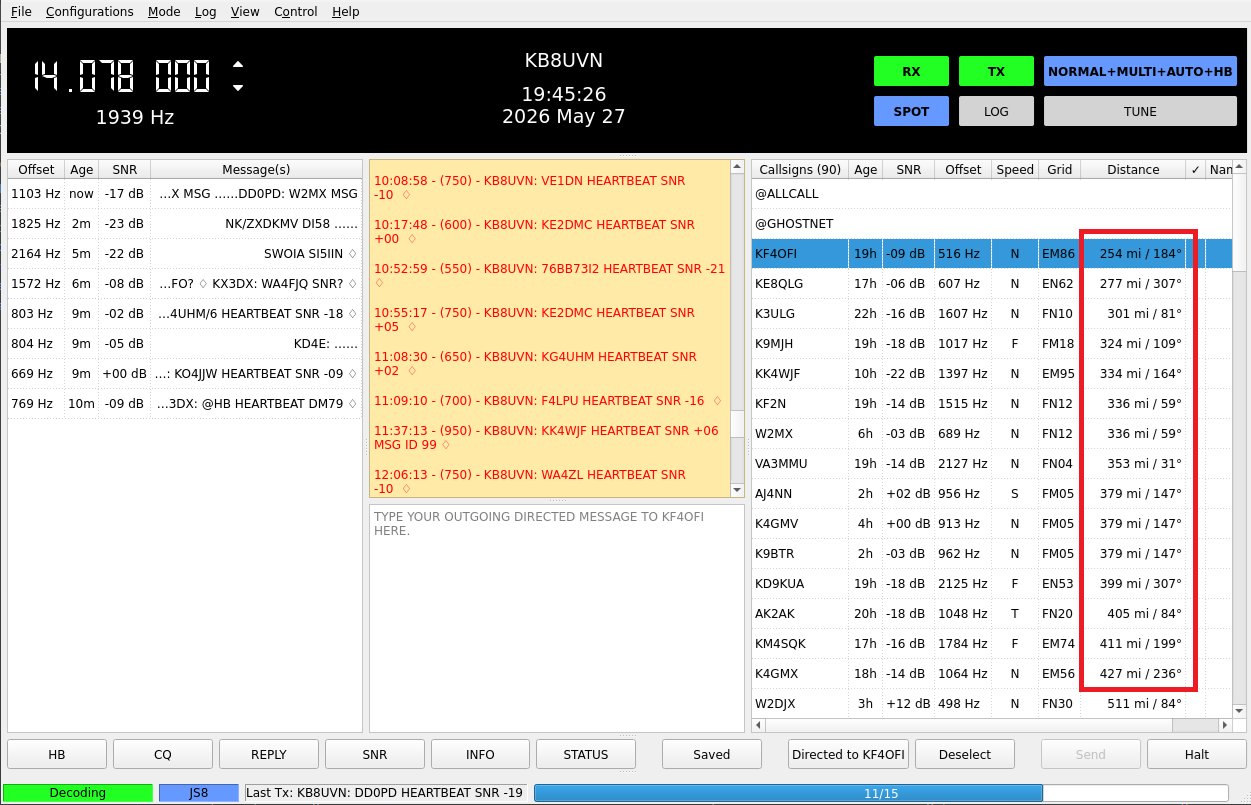
With the overarching goal of linking systems statewide, we must also employ antenna systems that favor NVIS type propagation. In general, this means horizontal (usually wire) antennas 1/8-1/4w wavelength above the ground or magnetic loops which are oriented vertically. For those interested in actual field strength tests, W8JI's NVIS page shows the height to performance numbers. For a quick reference, here are optimal antenna heights per band. Conventional wisdom suggest NVIS primarily happens below about 10 MHz, though real world testing with a vertical magnetic loop at 3ft above the ground has yielded contacts well beyond groundwave, but well within NVIS ranges. More experimentation may be needed to test it's feasibility on modes which require stronger signals.
| Band | Height |
| 20M | 8.25-16.5ft |
| 30M | 11.5-23ft |
| 40M | 16.5-33ft |
| 80M | 33-65ft |